Get this guide as a tappable itinerary
Day-by-day plan, audio tours, and one-tap Google Maps — completely free.



Monte Albán: Is It Actually Worth a Half-Day?
The honest answer depends on what kind of traveler you are.
Should you actually go?
Go if...
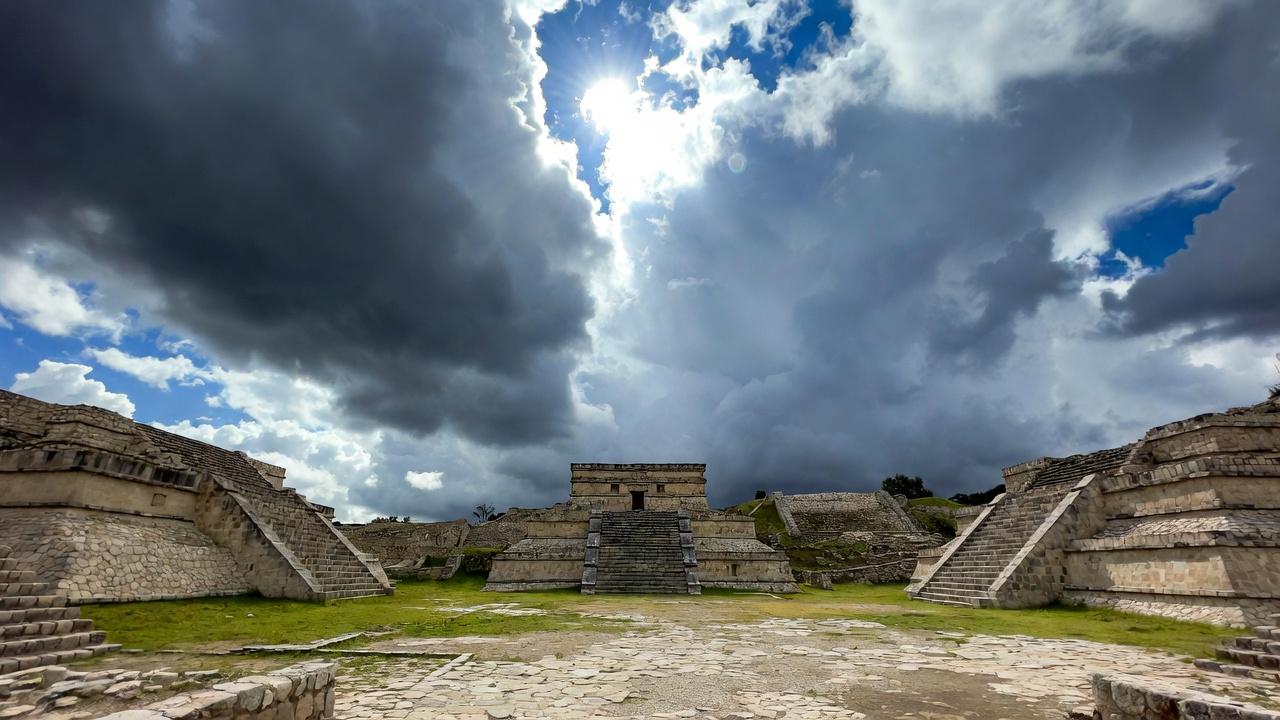
You're interested in pre-Columbian history, love open-air archaeological sites, or want to understand why the Zapotecs chose this mountaintop 2,500 years ago. The scale of the main plaza alone is worth the trip — it's a UNESCO World Heritage Siteand one of the earliest planned cities in Mesoamerica. The Zapotecs literally flattened a mountain ridge to build a civic-ceremonial center for 25,000 people. That engineering feat is staggering when you're standing in the middle of it.
Weigh it carefully if...
You have 3 days or fewer in Oaxaca. The half-day at Monte Albán means you're giving up an afternoon of markets, mezcal tastings, or neighborhood walking. If you have 4+ days, go — it fits comfortably on Day 2 or 3. If you have 3, weigh it against what you'd miss. The food scene, the textile villages, the mezcal palenques — those are things you can't do anywhere else. Monte Albán, while unique, is one of many excellent archaeological sites in Mexico.
How to get there (3 options)
Colectivo
Shared van, 30–40 min ride. Tell the driver “Monte Albán” — they'll drop you at the gate. Last return around 5 PM.
Taxi / DiDi
Ask the driver to wait (add ~200 MXN for 2 hours). Or take a colectivo up and taxi back. DiDi availability at the site is unreliable — have cash for a taxi.
Organized Tour
Includes transport + guide. The guide adds context you won't get on your own, but you're on their schedule and can't linger.
5-stop walking route
Main Plaza (Gran Plaza)
The massive central platform is 300m long. Walk to the center and stand still. You're looking at a city that was home to 25,000 people 1,500 years ago. The scale is what makes Monte Albán, not individual buildings. No photographs capture it — you have to be there, turning in a slow circle, to understand why the Zapotecs leveled a mountaintop for this.
Building J (The Observatory)
The arrow-shaped building at an odd angle to everything else. Aligned with stars, not with the plaza grid. Scholars still argue about exactly what it tracked. The carved stones on the sides are conquest records — lists of cities the Zapotecs defeated. It's the one structure that makes you realize these weren't just builders, they were astronomers and military strategists.
The Danzantes
Stone carvings of contorted human figures. Originally thought to be dancers (hence the name), now believed to depict tortured or sacrificed captives. They're the oldest thing at the site — 500 BCE. The gallery is on the west side of the plaza. Look for the closed eyes and open mouths — signs of death. Unsettling, powerful, and completely unlike the sanitized version of pre-Columbian history you get in textbooks.
North Platform
The highest point on the site. Climb the steps for a 360° panorama of the Oaxaca Valley. On a clear day you can see the Sierra Norte to the north and the Sierra Madre del Sur to the south. This is your photo spot — the one image that actually conveys the scale of Monte Albán. Morning light is dramatically better than afternoon.
Tomb 104
One of the few accessible tombs with original painted murals. The entrance is small and dimly lit. The paintings depict a figure dressed as Cocijo, the Zapotec rain god. Often missed because it's away from the main loop — ask a guard to point you in the right direction. The polychrome murals are remarkably well-preserved and worth the short detour.
Save your time
Monte Albán vs. Mitla
They're completely different experiences, so comparing them head-to-head is a bit misleading — but everyone asks, so here's the honest version.
Monte Albánis a mountaintop fortress city. Massive scale, panoramic views of the entire Oaxaca Valley, and the raw power of a Zapotec political capital that controlled the region for centuries. The structures themselves are modest, but the engineering — leveling a mountain ridge, building a 300-meter plaza — is what stuns you.
Mitlais a valley-floor temple complex with the finest stone mosaics (grecas) in Mesoamerica. Smaller, more intimate, architecturally more detailed. Mixtec-influenced rather than purely Zapotec. Where Monte Albán overwhelms with scale, Mitla captivates with craft — thousands of individually cut stone pieces fitted together without mortar to create geometric patterns that still look sharp after 1,000 years.
If you have time for both, do Monte Albán first (morning) and Mitla as a separate half-day. If you only have time for one: Monte Albán for the “wow” factor, Mitla for the craft.
Quick reference
90 MXN, managed by INAH. Free on Sundays for Mexican residents.
8 AM – 5 PM daily. Last entry at 4:30 PM.
Arrive by 9 AM to avoid heat and crowds. Morning light is also better for photos.
Water (at least 1 liter), sunscreen, hat. There's zero shade on the main plaza. A light rain jacket in summer (June–Sept).
Drones (prohibited). Tripods need a separate permit.