Get this guide as a tappable itinerary
Day-by-day plan, audio tours, and one-tap Google Maps — completely free.


12 Best Photography Spots in Oaxaca City
Optimal shooting times, specific directions, and crowd tips for every location — because great photos in Oaxaca are about light and timing, not gear.
Let's get something out of the way: you don't need an expensive camera to take great photos in Oaxaca. The city is absurdly photogenic — painted walls in every shade of terracotta and indigo, golden stone churches that glow at dawn, smoke-filled market corridors where light cuts through the haze like a stage effect. Your phone camera is fine. What matters is being at the right place when the light is right, and knowing which direction to face.
That's what this guide is about. Not gear. Not editing presets. Just 12 specific locations with the exact time of day the light is best, which direction to walk from, and when to arrive to beat the crowds (or embrace them). I've shot every spot on this list multiple times across different seasons, and the times I've given are consistent year-round because Oaxaca sits at 17° latitude — the sun angle doesn't shift dramatically between months.
Oaxaca sits at 1,550 meters elevation. That means the UV intensity is significantly higher than at sea level, and the midday sun creates harsh, unflattering shadows that blow out highlights and flatten colors. The good news is that golden hours here are generous — roughly 7–9 AM and 5–7 PM — giving you four full hours of beautiful light every day. Plan around those windows, and everything in between becomes time for eating, drinking mezcal, and staying in the shade.
Architectural Landmarks
Oaxaca's colonial architecture is built from cantera verde — a local green volcanic stone that shifts color throughout the day, from cool grey in the shade to warm gold in direct sunlight. The churches and civic buildings along the pedestrian corridor were designed to face east, which means morning light is the hero. Here are four architectural spots worth shooting deliberately rather than just snapping as you walk past.
Santo Domingo Church
The crown jewel of Oaxacan architecture. The baroque facade is covered in ornate stone carvings that catch every photon of morning light, turning from grey to gold as the sun climbs. The interior matches the exterior's intensity — gilded walls, painted ceilings — but photography inside is restricted to no-flash only. The real shot is the exterior from the plaza at street level, looking up at the facade with the sky behind.
IAGO Courtyard
The Instituto de Artes Gráficas de Oaxaca occupies a restored colonial house with a courtyard that shows up on every Oaxaca travel blog for a reason. Stone arcades frame a lush garden, and the diffused light filtering through the arcades creates soft, even illumination that's ideal for both wide shots and detail close-ups. The library upstairs has beautiful windows that frame the courtyard from above.
Cathedral at Zócalo
Oaxaca's cathedral sits on the north side of the main square and is best photographed from the south side in the late afternoon when the west-setting sun catches the green stone at a low angle, saturating the color and adding depth to the carvings. The plaza's Indian laurel trees frame the shot naturally. At sunset, the entire facade turns golden-green — a color that only exists in Oaxacan stone at that hour.
Andador Turístico
The pedestrian-only street running from Santo Domingo south to the Zócalo is lined with restored colonial buildings, galleries, and cafés. It's a corridor shot waiting to happen — the narrow street creates natural leading lines, and late afternoon light rakes across the facades from the west, creating dramatic shadow patterns on the stone. Walk north-to-south so the light is behind you and illuminating the buildings ahead.
Street Life & Markets
Oaxaca's street life is where the city reveals its character. The markets, painted neighborhoods, and plazas are not static backdrops — they're living, shifting scenes where light, smoke, and human activity combine differently every hour. These four spots reward patience and return visits. Each one looks completely different at 7 AM versus 7 PM, so the optimal times below are suggestions, not rules.
Jalatlaco Colorful Streets
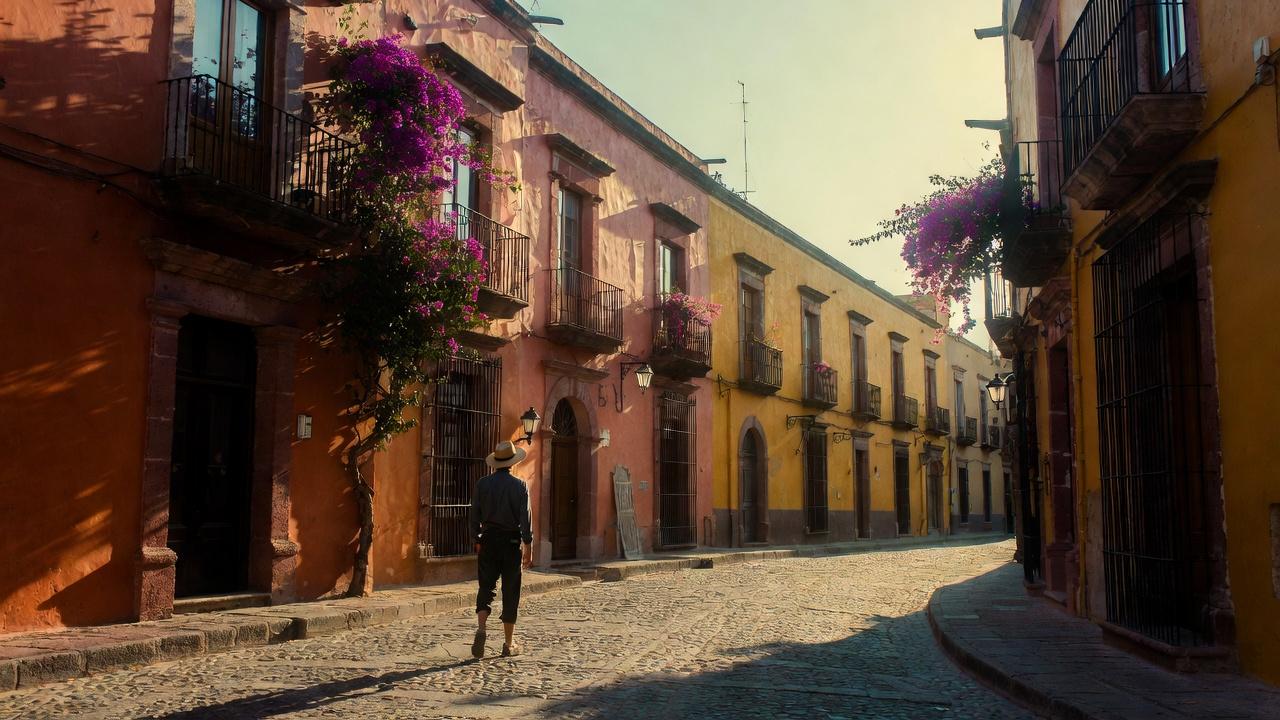
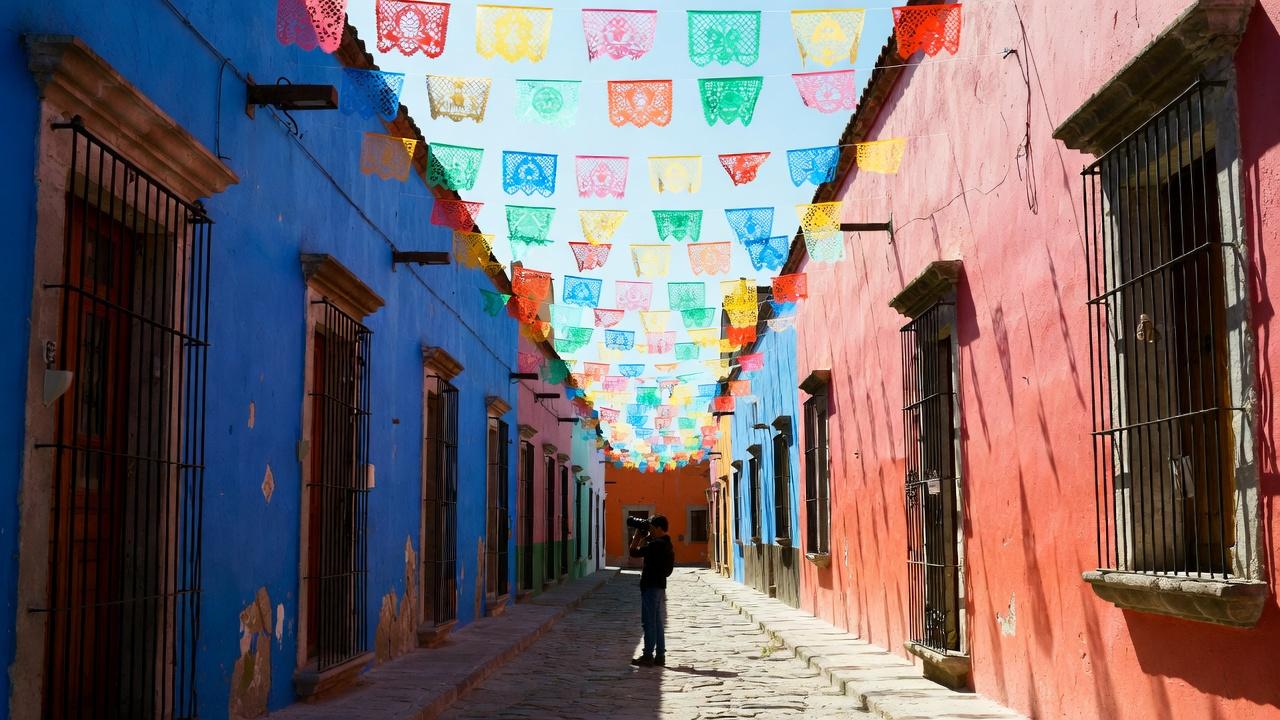
The Jalatlaco neighborhood southeast of the Centro is Oaxaca's most colorful district — every house is painted a different shade, with bougainvillea spilling over walls and hand-painted murals on every third door. The magic hour here is late afternoon when the west-facing walls catch golden light and the shadows go long. Walk the blocks south of Calle Reforma, where the streets narrow and the colors intensify. The corner of Rufino Tamayo and Constitución is a classic shot.
Mercado 20 de Noviembre — Pasillo de Humo
The 'Smoke Corridor' in the back of Mercado 20 de Noviembre looks like a film set — thick charcoal smoke, shafts of overhead light, zero staging required. Rows of open charcoal grills fill the narrow aisle with thick smoke, and shafts of light from the high ceiling cut through the haze like spotlights on a stage. The vendors fan their grills, sending columns of smoke upward. It's moody, atmospheric, and almost cinematic without any editing. The meat starts grilling around 8:30 AM — arrive by then to catch the first smoke before the air gets too thick.
Zócalo at Night
The Zócalo transforms completely after dark. String lights canopy the trees, balloon vendors trail clusters of glowing orbs, families promenade, and food carts ring the perimeter with warm pools of light. The combination of ambient artificial light and human activity creates a warm, textured nightscape that looks great even on phone cameras. Shoot from any corner — the diagonal views across the square catch the most depth. The cathedral, lit from below, provides a natural focal point in the background.
Street Vendors on Calle Mina
Calle Mina between the market and the Zócalo is where Oaxaca's morning food economy happens. By 6:30 AM, vendors are setting up folding tables, laying out towers of pan de yema, unwrapping tamales from banana leaves, and heating pots of chocolate atole on portable stoves. Steam rises from every cart, catching the early light. By 8 AM the street is in full flow — the best shots come in that 6:30–8 AM window when it's all being assembled and the light is soft and directional.
Views & Natural Landscapes
Beyond the colonial center, Oaxaca's surrounding valley offers landscapes that range from pre-Columbian ruins perched on mountaintops to petrified waterfalls and cactus gardens. These four spots require a bit more planning — early starts, transport logistics, or guided-tour bookings — but the payoff is images that go far beyond the typical Oaxaca City Instagram feed.
Monte Albán Main Plaza
The ancient Zapotec capital sits on a flattened mountaintop overlooking the Oaxaca Valley, and the main plaza — a vast, open ceremonial space surrounded by pyramids and platforms — opens up into a 300-meter-long ceremonial plaza ringed by pyramids, with the whole Oaxaca Valley spread below. The low morning sun creates long shadows across the stone structures, adding depth and drama to what could otherwise look flat. Climb to the top of the South Platform for a panoramic view of the entire site with the valley below. The scale is almost impossible to capture in a single frame — shoot panoramas.
Cerro del Fortín Lookout
The hill above the Guelaguetza amphitheater offers the best panoramic view of Oaxaca City, with the valley stretching to the mountains in every direction. At sunset, the city below catches the last warm light while the surrounding sierra turns purple and blue. You can walk up via Calle Crespo in about 25 minutes (steep but paved), or take a taxi for 40 MXN. The amphitheater's concrete steps make for a good foreground element with the cityscape behind. On clear days, you can see all the way to Monte Albán.
Jardín Etnobotánico
The Ethnobotanical Garden behind the Santo Domingo complex is a curated collection of Oaxacan plant species — towering columnar cacti, centuries-old trees, and arid-landscape plants arranged in an almost sculptural layout. The dappled light filtering through the canopy creates a constantly shifting pattern on the ground, and the cacti cast geometric shadows that look almost like an art installation. The catch: you can only enter via a guided tour (Spanish tours daily, English tours Tuesdays and Thursdays). Book in advance during high season.
Hierve el Agua
The petrified waterfalls and infinity pools at Hierve el Agua sit on a cliff edge with a view over the Mitla valley that looks rendered, not real. The mineral-crusted cascades catch sunrise light beautifully, turning from white to gold as the sun breaks over the eastern mountains. The infinity pools in the foreground with the valley behind is the classic shot. If you arrive at opening (around 7 AM from the parking area), you'll have the cascades entirely to yourself for 30–45 minutes before the first tour groups arrive. That window is worth every minute of the early drive.
Camera Tips for Oaxaca
Oaxaca's altitude, light intensity, and street-level conditions create specific challenges that are worth knowing about before you start shooting. None of these are dealbreakers — just adjustments that will noticeably improve your results.
UV Intensity at 1,550m
At Oaxaca's elevation, UV radiation is roughly 20% stronger than at sea level. Photographically, this means the midday sun between 11 AM and 3 PM creates extremely harsh shadows with very little detail in the highlight areas. Cameras and phones auto-expose for the bright areas and let shadows go black, or they expose for shadows and blow out the sky. There's no middle ground at noon. The solution is simple: don't shoot important subjects between 11 and 3. Use those hours for eating, resting, or exploring indoor markets where the light is diffused.
Golden Hours Are Generous
Because Oaxaca is at 17° north latitude, the sun rises and sets at a relatively moderate angle year-round. This means golden hour isn't a 20-minute scramble like it is in northern latitudes — you get a solid two-hour window of warm, directional light both morning (7–9 AM) and evening (5–7 PM). That's four hours of ideal light every single day. Use them. The morning window is slightly bluer and cleaner; the evening window is warmer and hazier. Both work beautifully for Oaxaca's colorful subjects.
Phone Camera Tips
Clean your lens. Oaxaca is dusty, and a smudged phone lens creates haze that you'll blame on the air quality. Wipe it with a soft cloth before every session. This one habit improves phone photos more than any editing app.
Tap to lock exposure. In scenes with bright sky and dark foreground (common in Oaxaca), tap on the subject you want properly exposed and hold until the exposure locks. On iPhone, you'll see “AE/AF Lock.” This prevents the camera from constantly re-metering as you compose.
Skip the ultra-wide for architecture. Ultra-wide lenses distort vertical lines, making buildings look like they're falling backward. Use your phone's main (1x) lens for architecture, and step back if you need more in the frame. The results are dramatically better.
Markets Are Low-Light Environments
Mercado 20 de Noviembre and Mercado Benito Juárez are roofed structures with limited natural light reaching the inner stalls. Phone cameras compensate by slowing the shutter speed, which means motion blur if your hands aren't steady. Brace your elbows against your body or lean on a column. If your phone has a “Night Mode” or “Low Light” setting, use it — it takes a multi-frame composite that reduces noise and blur. Take a breath, hold still for one second, and you'll get a sharp shot even in the dim inner corridors.