Get this guide as a tappable itinerary
Day-by-day plan, audio tours, and one-tap Google Maps — completely free.


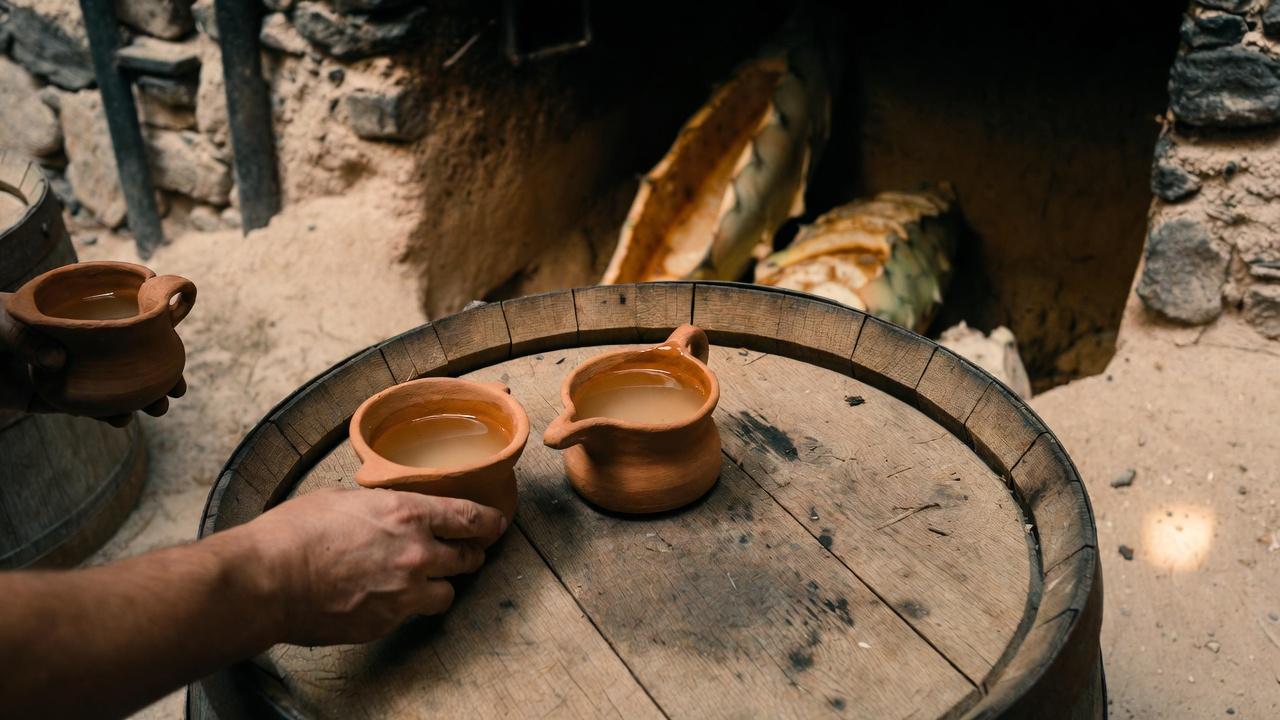
Oaxaca Mezcal Guide: What to Drink, Where to Drink It
A practical guide to understanding mezcal, finding the best bars, visiting distilleries, and buying bottles to take home — with prices, addresses, and opinions.
Every travel guide tells you to “try mezcal in Oaxaca.” None of them tell you what to actually order when you're standing at a bar looking at 40 unlabeled bottles, a bartender who speaks rapid Oaxacan Spanish, and a menu that lists agave varieties like they're Pokémon you should already recognize.
This is not a cocktail guide. You don't need cocktail recipes for Oaxaca — the mezcal here is meant to be sipped straight, slowly, from a jicara or a wide glass. This guide is about understanding what you're tasting, knowing which bars are worth your time (and which are tourist traps pouring industrial spirit), and having the confidence to walk into a mezcalería, point at a bottle of tobazíche, and know roughly what's about to hit your palate.
I've spent enough mornings in Oaxaca regretting the night before to know what's good and what's a waste of pesos. Everything here is specific: real addresses, prices in MXN, and honest opinions about what's overrated and what isn't.
Understanding Mezcal: The Four Agaves You'll See Everywhere
There are over 50 agave species used in mezcal production, but in Oaxaca's bars, four dominate the menu. Understanding these four is enough to order confidently and know whether you're getting good value. Think of this as the difference between knowing “red wine” and knowing the difference between a Tempranillo and a Malbec — it completely changes the experience.
Each card below shows the agave type, production method, flavor profile, and what you should expect to pay per pour at a mezcalería in Oaxaca City. The radar charts show relative flavor intensity on six axes — they're subjective, but they'll give you a rough idea before you taste.
Espad\u00edn
Tobal\u00e1
Madrecuixe
The 5 Best Mezcalerías in Oaxaca City
There are easily 30+ mezcal bars in Oaxaca's Centro, and most of them are fine. These five are more than fine — they're each doing something distinct, and together they cover every kind of mezcal experience you might want: educational, casual, rare, food-paired, and cheap. Hit two or three across your trip and you'll cover serious ground.
In Situ
The mezcalería most people start with, and for good reason. In Situ carries dozens of producers from across the Oaxacan valleys, with an emphasis on small-batch artesanal labels you won’t find outside the state. The staff actually know what they’re pouring — they’ll walk you through agave types, production methods, and flavor profiles without making you feel like a student. The courtyard seating is pleasant, and the pours are honest. This is where you learn what you like before branching out.
Mezcaloteca
This is not a bar. It’s a guided tasting room, and you need to book ahead or arrive early and hope for a cancellation. A mezcalero sits with your group (usually 4–8 people) and walks you through a curated flight of 4–6 mezcals, explaining terroir, fermentation, and distillation as you go. You’ll taste things here — wild agaves from remote mountain villages, pechuga distilled with turkey breast — that simply don’t appear on bar menus. This is the deepest mezcal education available to a casual visitor.
Los Siete Moles
Technically a restaurant, but the mezcal list is better than half the dedicated bars in town. The concept is pairing mezcal with Oaxacan food — their seven moles are the backbone of the menu, and each one shifts the mezcal on your palate in a different direction. Order the mole negro with a joven espadín and you’ll understand why Oaxacans don’t drink mezcal on an empty stomach. The roof terrace fills up by 8 PM on weekends.
Archivo Maguey
Archivo is where you go after you’ve done In Situ and Mezcaloteca and decided you need to go deeper. Their focus is on wild and semi-wild agaves — tobaziche, coyote, cuishe, sierra negra — from producers who make a few hundred liters a year. Some bottles behind the bar don’t have labels. Prices are higher because the agaves are rarer and the production runs smaller, but this is not a tourist markup — these are spirits made in batches of 200–400 liters from agaves that took 12–25 years to mature. The bartenders are passionate and opinionated. Ask them what’s interesting right now.
La Mezcalerita
The antidote to mezcal snobbery. La Mezcalerita is a small, unpretentious spot where locals drink cheap, good espadín and nobody lectures you about terroir. Pours start at 40 MXN, which is about as low as it goes in the Centro without sacrificing quality. There’s no menu of rare agaves — just solid everyday mezcal, a few tobalás if you’re lucky, and a vibe that says “sit down, drink, don’t overthink it.” Perfect for your third or fourth bar of the night.
Distillery Day Trips: Santiago Matatlán
Santiago Matatlán sits about 50 km southeast of Oaxaca City and calls itself the “World Capital of Mezcal.” That's a bold claim, but it's not wrong — the valley is dotted with palenques (small distilleries) where families have been making mezcal for generations. Some of these operations are literally a pit in the ground, a horse-drawn tahona, and a wood-fired copper still in somebody's backyard.
The drive takes about 30 minutes on a paved highway. Along the road into town, you'll see signs for palenques on both sides — some are legitimate family operations, others are essentially tourist shops with a decorative still out front. Here's how to tell the difference and what to expect.
Getting There
Colectivo (cheapest): Shared vans leave from the second-class bus terminal (Central de Abastos) roughly every 20 minutes. Cost is 30 MXN each way. Journey time is 40–50 minutes depending on stops. Tell the driver “Matatlán, por favor” so he drops you in the town center, not at a roadside palenque.
Taxi: A private taxi from the Centro costs around 350–500 MXN one way. Negotiate a round trip with waiting time for 800–1,200 MXN total. This is the best option if you want to visit multiple palenques, since they're spread along the highway.
Organized tour: Runs 400–900 MXN per person, usually includes 2–3 palenque visits and lunch. Fine if you don't want logistics, but you lose flexibility and spend time at places chosen for their commission rate, not their mezcal.
What to Expect at a Palenque
A typical visit lasts 30–60 minutes. The mezcalero will walk you through the entire process: the earthen pit where agave piñas are roasted over volcanic rock for 3–5 days, the stone tahona pulled by horse to crush the cooked agave, the wooden vats where natural fermentation happens over 1–2 weeks, and finally the copper or clay stills. Most palenques offer free tastings of 3–5 varieties at the end — this is where they hope you'll buy bottles.
The best palenques are the ones where you can see active production — smoke rising from the pit, agave fibers drying in the sun, fermentation bubbling in the tinas. If everything looks like a museum exhibit and the still is spotless, you're at a showroom, not a working distillery.
Buying Mezcal to Take Home
Mezcal costs a fraction of export prices when you buy it here. Bottles that retail for $50–80 USD in the States cost 200–400 MXN ($12–24 USD) here. Even rare wild agave mezcals that would be $120+ in Brooklyn are 600–1,000 MXN in a Oaxacan shop. The catch is knowing what to buy and what to avoid.
What to Look For on the Label
Artesanal or Ancestral: These are the two production categories worth buying, as defined by the Consejo Regulador del Mezcal(CRM). Artesanal means earthen-pit roasted agave, stone-crushed, and copper-distilled. Ancestral means the same but distilled in clay pots instead of copper — it's the oldest method and produces a more rustic, complex spirit. Avoid anything labeled “industrial” or “mezcal” with no category specified.
Agave type:It should name the specific agave (espadín, tobala, etc.). If it just says “maguey” without specifying, that's a red flag.
Mezcalero name: Good mezcal names its maker. If there's no producer name, it's likely an industrial blend from an anonymous source.
ABV:Look for 45–55%. Below 40% suggests it's been watered down. Above 55% is unusual but not necessarily bad. Most quality artesanal mezcal sits at 47–49%.
Price Ranges (Bottles)
Artesanal espadín: 150–300 MXN — The everyday workhorse. Buy two: one to drink, one to gift.
Tobalá: 400–800 MXN — The “impress your friends” bottle. Floral, complex, and unlike anything they've tasted.
Wild agaves (tobaziche, cuishe, madrecuixe): 500–1,200 MXN — For the serious collector. These are limited runs from agaves that grow wild in the mountains.
Pechuga: 800–2,000 MXN — The ceremonial stuff. Buy it if you tried it at a bar and loved it.
Packing Mezcal for Flights
Checked luggage only — no exceptions. Wrap each bottle in at least two layers of clothing, then seal it inside a gallon-size ziplock bag. If a bottle breaks mid-flight, the bag saves your wardrobe. Many shops in Oaxaca will bubble-wrap bottles for free if you ask; some sell foam bottle sleeves for 15–20 MXN.
Most airlines allow up to 5 liters of alcohol per passenger in checked bags (verify with your carrier). Two 750ml bottles is a safe, practical limit per bag — any more and you risk weight overages and awkward packing geometry.
If you're buying at a palenque and the bottle is reused plastic, that's actually a bonus for travel — lighter and unbreakable. Just make sure the cap seals properly.
Tasting Vocabulary: Seven Words You Need
You don't need a sommelier vocabulary to enjoy mezcal, but knowing these seven terms will help you read menus, talk to bartenders, and understand what you're paying for.
Joven
HO-venUnaged mezcal, bottled shortly after distillation. This is what you want 90% of the time. Clear, pure expression of the agave without barrel influence. Most mezcal in Oaxaca is joven.
Reposado
reh-poh-SAH-dohRested in wood for 2–12 months. Picks up mild vanilla and caramel notes from the barrel. Divisive among mezcal purists — some argue the wood masks the agave flavor. Worth trying once, but joven is the standard.
Pechuga
peh-CHOO-gahMezcal redistilled with a raw chicken or turkey breast hung inside the still, along with fruits, nuts, and spices. The result is silky, fruity, and faintly savory. Made for celebrations. Expensive but extraordinary.
Ancestral
ahn-seh-STRAHLThe oldest production method: earthen pit roast, stone tahona crush, open-air fermentation, clay pot distillation. Produces the most rustic, textured mezcals. If you see it on a menu, order it.
Artesanal
ar-teh-sah-NAHLTraditional production using earthen pit roasting and either copper or clay distillation. The middle ground between ancestral and industrial. This is where most good mezcal lives.
Industrial
een-doos-tree-AHLMade with autoclaves (steam ovens), mechanical shredders, and stainless steel stills. Faster and cheaper, but strips out much of the character. Avoid this category unless you’re mixing cocktails and don’t care.
Capón
kah-POHNAn agave whose flowering stalk (quiote) has been cut before it blooms, forcing all the plant’s sugars to concentrate in the piña. Most mezcal agaves are capón. It’s what gives good mezcal its sweetness and depth.